A capital call is a request for more money from investors after they've already funded a deal. In a syndication it usually signals a cash shortfall. Whether a call can hurt an investor comes down to two documents read before investing. The operating agreement sets the penalties for declining and the loan terms predict how likely a call is.
What is a capital call in real estate?
In a private equity or drawdown fund, the capital call is the plan. You sign a commitment for a set amount. The manager draws it as deals come up, so you keep it liquid until the commitment is fully drawn.
In a syndication, the money goes in at closing. Jim Dahle of The White Coat Investor (WCI) separates the call that funds the investment from the unexpected one in Should You Meet the Capital Call? The calls that worry investors are the unexpected ones. By the time one goes out, the deal is typically cash-flow negative and the reserves are gone or close to it.
Where do capital calls come from?
The usual causes:
- A renovation that runs over budget
- Occupancy that drops and stays down
- A refinance that comes in short of the loan it has to pay off
- A floating-rate payment that jumps
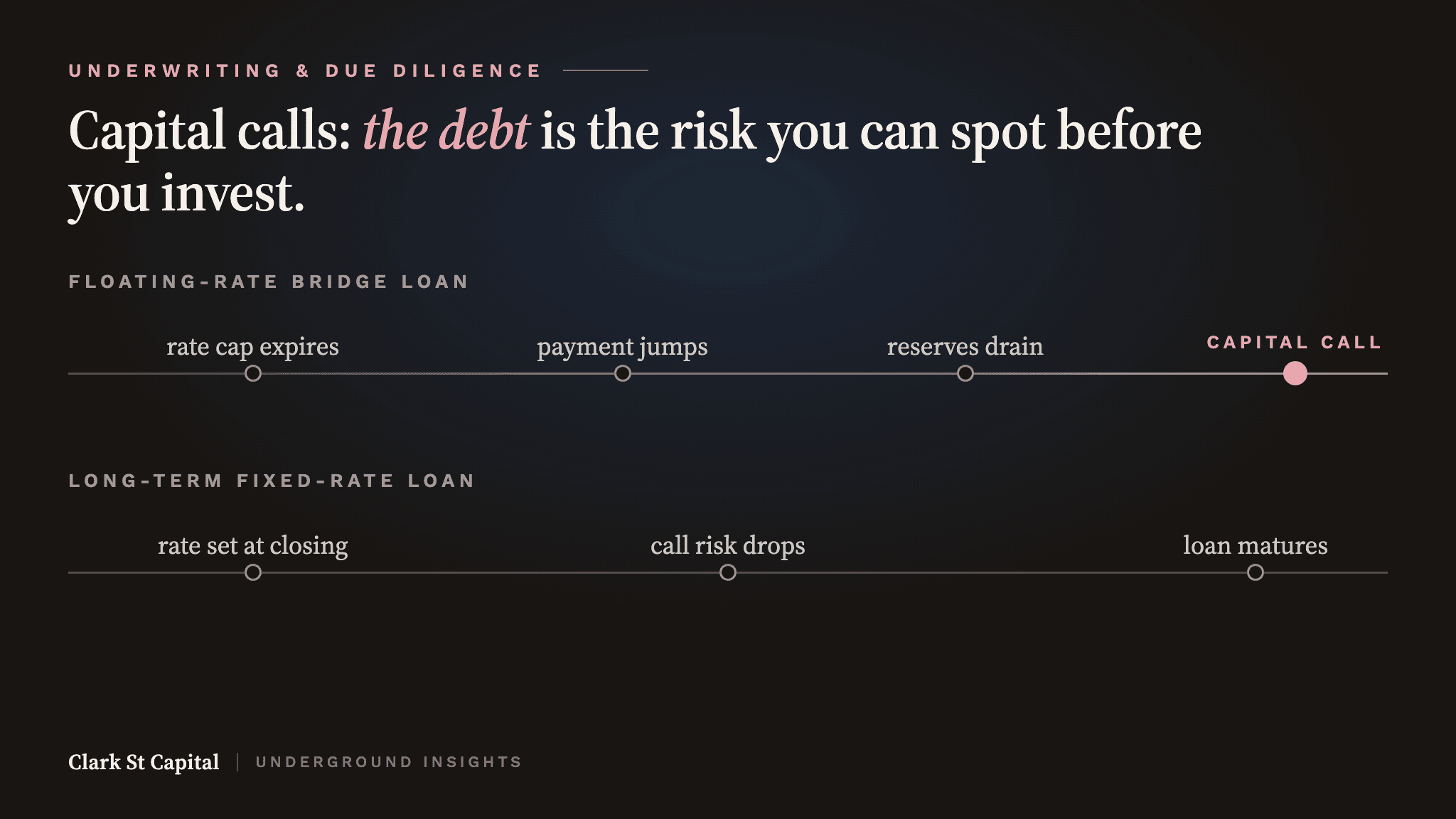
The last one is the one you can spot before you invest. Floating-rate bridge loans usually come with an interest rate cap. The cap limits how high the rate can go, but only for a set term and replacing it gets expensive when rates are high. Freddie Mac's January 2024 Multifamily Maturity Risk report said floating-rate loans "may experience more stress given the adjustment to higher rates and interest rate cap premiums."
When the payment outruns the rent and the reserves run dry, the sponsor needs cash. WCI lists four places to get it: the sponsor itself, another lender, new investors or the original investors. The original investors are often easier to reach than new ones.
The same article names ways the sponsor could have taken less risk: spending less on renovations or spending it slower, holding more cash in reserve, putting more money down and using less variable-rate debt.
What happens if you don't meet a capital call?
The operating agreement decides. WCI describes three outcomes to look for.
- Dilution. In WCI's example, you own $100,000 of a $10 million raise, which is 1%. The sponsor calls $5 million. If everyone else pays and you don't, your stake drops to 0.67%.
- Better terms for the new money. The fresh capital can come in ahead of yours.
- Penalties. Some agreements go as far as the loss of some or all of your original capital.
If nobody meets the call, the deal can fail and everyone's capital can be lost. WCI's advice is to treat any call as a brand new investment and do the same due diligence you'd do on a new deal.
This isn't legal advice. Have your own attorney read the operating agreement before you sign it.
Where capital calls fit in your financial journey
Two years into a syndication, the sponsor could email every investor asking for more cash. Wire it and more money rides on a deal that already came up short. Decline it and your stake already in the deal can shrink or, under some agreements, disappear.
So the best time to understand a capital call situation is before you invest.
Size the check so a total loss can't change your plans. Before you invest, assume the money could go to zero and that you'll decline any call. If that outcome would delay your retirement, your kids' tuition or a house, the check is too big.
Keep call reserves outside the deal. Look for a cap on additional contributions in the operating agreement. If there's one, set that amount aside in cash, separate from your emergency fund.
Example with hypothetical numbers: you invest $50,000 and the agreement caps calls at 25% of original contributions. Your largest possible call is $12,500. Hold it outside the deal. If losing the full $62,500 would change your plans, invest less. If the agreement has no cap, you can't size a reserve, so plan to decline and size the original check accordingly.
Read the debt before the returns. The loan tells you more about call risk than the projected return does.
- A floating-rate bridge loan with a short maturity and a rate cap that expires before the business plan finishes carries the most call risk.
- A long-term fixed-rate loan sets the rate at closing. If it starts interest-only, the payment still rises when amortization begins. Call risk drops, but a renovation overrun or an occupancy slump can still cause a shortfall.
- A construction loan that converts to long-term debt carries risk until the permanent loan closes.
Who should avoid call-exposed structures. If you're still building an emergency fund, need the money back inside the hold period or can only afford one deal, a syndication with call rights is a poor fit. A drawdown fund needs a different kind of liquidity. You have to keep the full unfunded commitment available for years.
If you'd feel forced to meet a call to protect your first check, you're overexposed. Reconsider the investment.
Questions to ask any sponsor or fund about capital calls
- Is the debt fixed or floating and when does it mature? If it floats, when does the rate cap expire and what does a replacement cost?
- How many months of reserves does the deal hold? Do they cover debt payments and operating costs? Where is the cash held?
- Does the operating agreement allow capital calls? Is there a cap on additional contributions?
- What happens to an investor who declines: dilution, subordination or forfeiture?
- Has the sponsor ever issued a capital call? What caused it and how did it end?
- Does the sponsor ever borrow to fund distributions?
- For a fund: are commitments drawn over time or funded up front, and what are the penalties for missing a drawdown?
FAQ
How does a capital call work?
The sponsor sends investors a notice asking for more money by a deadline. The operating agreement sets the process, including what happens to an investor who passes.
What happens if you don't meet a capital call?
Your ownership gets diluted if the others pay. Some agreements add better terms for the new money or penalties, up to the loss of your original capital.
Is a capital call a bad sign?
In a drawdown fund, no. It's how the fund was designed to work. In a syndication, usually yes. It means the deal needs cash it didn't plan for.
Can a real estate debt fund make a capital call?
It depends on the fund's documents. Some funds draw commitments over time. Others take the full amount up front and have no call rights.
Ask and understand before you invest.
For how the two structures differ, see debt fund vs. real estate syndication and how to compare real estate debt funds. For the basics of the equity side, see what is a real estate syndication.
About Ed Mathews
Ed is the President of Clark St Capital. He started investing in 2011 after analyzing deal after deal and making zero offers, until a mentor handed him a pen and made him sign his first contract. Since then, Clark St has operated across single-family, multifamily and land development, with Ed also invested as a limited partner in funds and large multifamily projects. Ed also spent more than two decades in Silicon Valley building systems for global companies. He hosts the Real Estate Underground podcast, with new episodes every Tuesday at 12pm.