TL;DR
- Underwriting isn't a test designed to reject you. It's risk mitigation, and a good lender's process works in your favor.
- What it's really doing is confirming you're who you say you are, across three things: experience, financial stability and character.
- The overlooked upside is that a second set of experienced eyes catches things you may have missed on the deal, before your money is at risk.
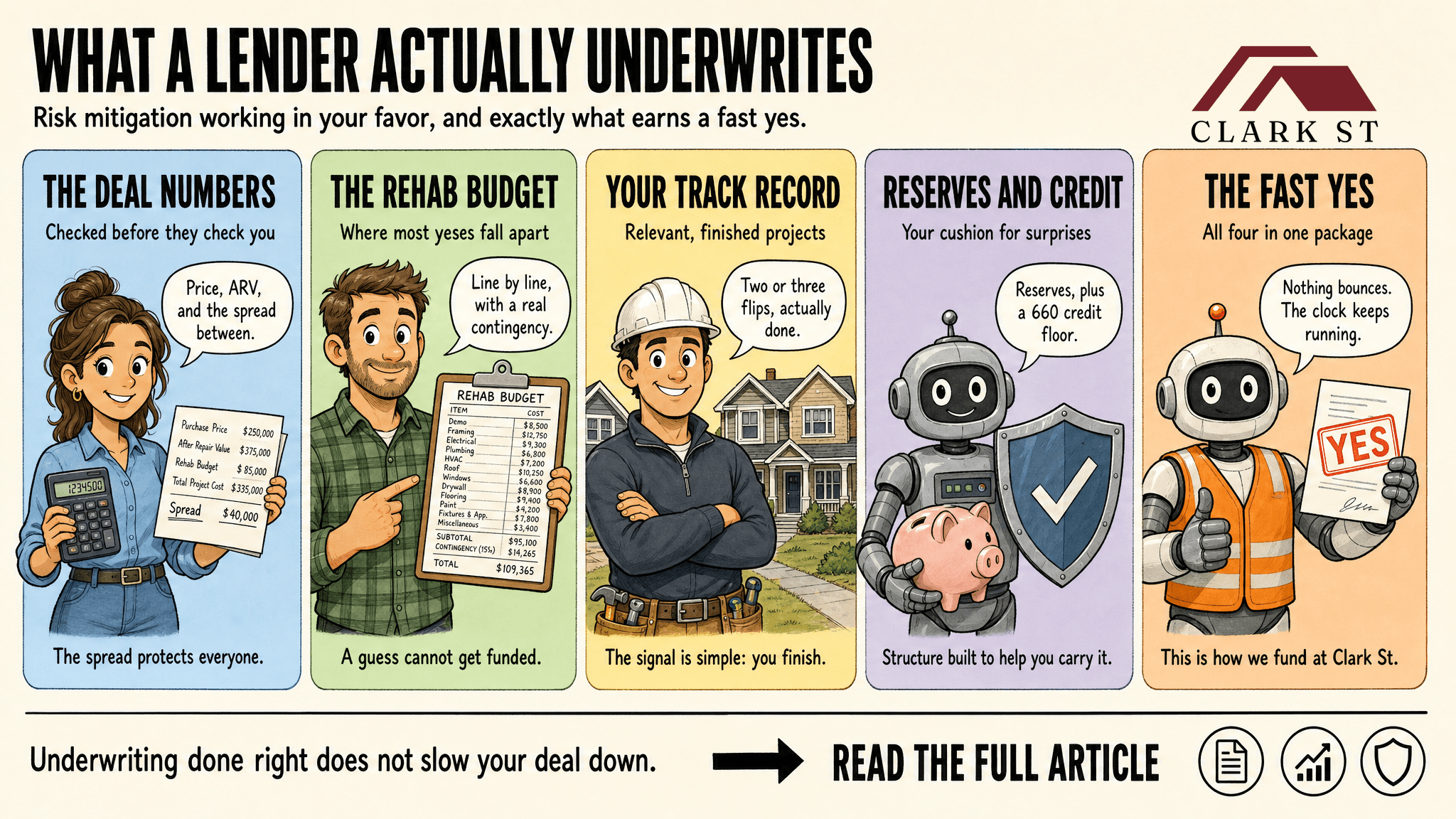
- A lender looks at the deal numbers first, then the rehab budget, then your track record, then your reserves and credit.
- Package all four before you submit and the yes comes fast.
Underwriting is risk mitigation, not a gate
Most operators hear the word underwriting and tense up. They picture a stranger looking for a reason to say no. That's not quite accurate.
Underwriting is about risk mitigation. That's all it is.
A lender is putting real money into your deal. Before they do, they want to know the deal is sound and you can carry it to the finish. That's not the lender being difficult. That's the lender pricing risk and, in parallel, protecting you from making a mistake. The lower the real risk, the easier the yes.
Here's the part that helps you. When the person underwriting your deal has run flips themselves, that process works in your favor. They aren't just protecting their money. They're protecting yours too, because your cash is in the deal alongside theirs. We've flipped houses more than 75 times. When we underwrite your deal, we are reading it the way we read our own.
What a lender is really checking
Strip away the paperwork and underwriting is answering one question. Are you who you say you are?
That breaks into three key elements:
Experience. Have you done this before? A track record of finished projects tells a lender you know what a rehab actually costs and how a job goes sideways.
Financial stability. Do you have reserves to carry the project, just in case? Deals run long. Surprises show up when the walls open. A lender wants to know a rough stretch will not sink you.
Character. Do you do what you say? This is the quiet one and it matters most. A lender is betting that when you commit to a scope and a timeline, you deliver.
None of that's personal. It's how a lender measures risk before it prices a loan. Clear those three and you're most of the way to funded.
The upside nobody tells you about
Here is the part almost no one frames right. A good lender's underwriting catches things you may have missed.
You've been staring at your own deal for weeks. You're close to it. You want it to work. That's exactly when a spreadsheet starts telling you what you want to hear. An experienced lender walks in cold. They have seen hundreds of these. They will spot the ARV that's a reach, the rehab line that's light, the timeline that doesn't match the scope.
That's not an obstacle. That's a gift. A second set of experienced eyes on your deal, before your money is on the line, is one of the most valuable things you can get for free. We've caught problems in a borrower's numbers that would have cost them far more than the loan ever did. Better to hear it during underwriting than three months into a rehab you can't finish.
The deal numbers come first
Before a lender looks at you at all, they look at the deal.
Three numbers:
- The purchase price.
- The credible after-repair value.
- The spread between them.
That spread is the deal. It's what protects everyone if the market shifts or the job runs long.
Credible is the key word on ARV. Not the best comp on the block. The realistic one. A lender who knows the local market can tell the difference in about a minute, and an inflated ARV is the fastest way to lose their confidence on everything else you submit.
The rehab budget makes or breaks the yes
After the numbers, a lender goes to your rehab budget. This is where most yeses fall apart.
A credible budget holds up line by line. Scope, materials, labor, permits and a real contingency for the things you always find in a 1-4 unit value-add. The scope has to match the timeline too. A gut rehab doesn't happen in three weeks, and a budget that says it will tells the lender you have not run the job in your head.
A weak budget is the number one reason a good deal stalls in underwriting. A round number with no detail reads as a guess, and a lender can't fund a guess, at least not without a contingency reserve. We'll cover how to build a budget that gets fully funded in a later piece.
For now, know this: a real budget isn't just what gets you approved. When the rehab is funded through draws, that budget is also what keeps your own cash reserves out of the renovation.
Your track record and your reserves
Now the lender looks at you.
Track record doesn't mean a huge portfolio. It means relevant, finished projects on deals like this one. Two or three completed Connecticut flips tell a lender more than a resume full of half-done ideas. The signal is simple. You know how to finish.
Then they look at reserves and credit. Reserves are your cushion for the surprises every rehab throws at you. Credit matters too; most lenders in this space set a floor around 660. This is also where a real protection lives that most operators overlook.
A well-built loan carries a 6-month interest reserve, so your first six months of interest payments are already funded. The underwriting confirms you can carry the deal. The structure should be built to help you carry it.
How to package a submission that gets a fast yes
Put it all together and the picture is clear. A lender says yes to four things:
- Clear deal numbers
- A credible rehab budget
- A real track record
- Reserves that show you can carry it
You need to have all four at the ready.
Bring the purchase price and the honest ARV. Bring the rehab budget with a real contingency line. Bring proof of the deals you have finished. Bring your reserves and your credit. When all of that lands in one package, nothing bounces back and the clock doesn't restart. You get an answer fast.
That's the most important point. Underwriting done right doesn't slow your deal down. It's how a partner makes sure the deal is one you should be doing at all.
If you have a Connecticut flip (1-4 units) and want a funding partner who understands your deal the way you do, here's how we fund deals: /borrow.
If you have any questions, I'm a cheap date. Give me a shout. Happy to help.
About Ed Mathews
Ed is the founder of Clark St Capital, Clark St Homes and Elevista. He started investing in 2011 after analyzing deal after deal and making zero offers, until a mentor handed him a pen and made him sign his first contract. Since then, Clark St has operated across single-family, multifamily and land development, with Ed also invested as a limited partner in funds and large multifamily projects. Ed also spent more than two decades in Silicon Valley building systems for global companies. He hosts the Real Estate Underground podcast, with new episodes every Tuesday at 12pm.