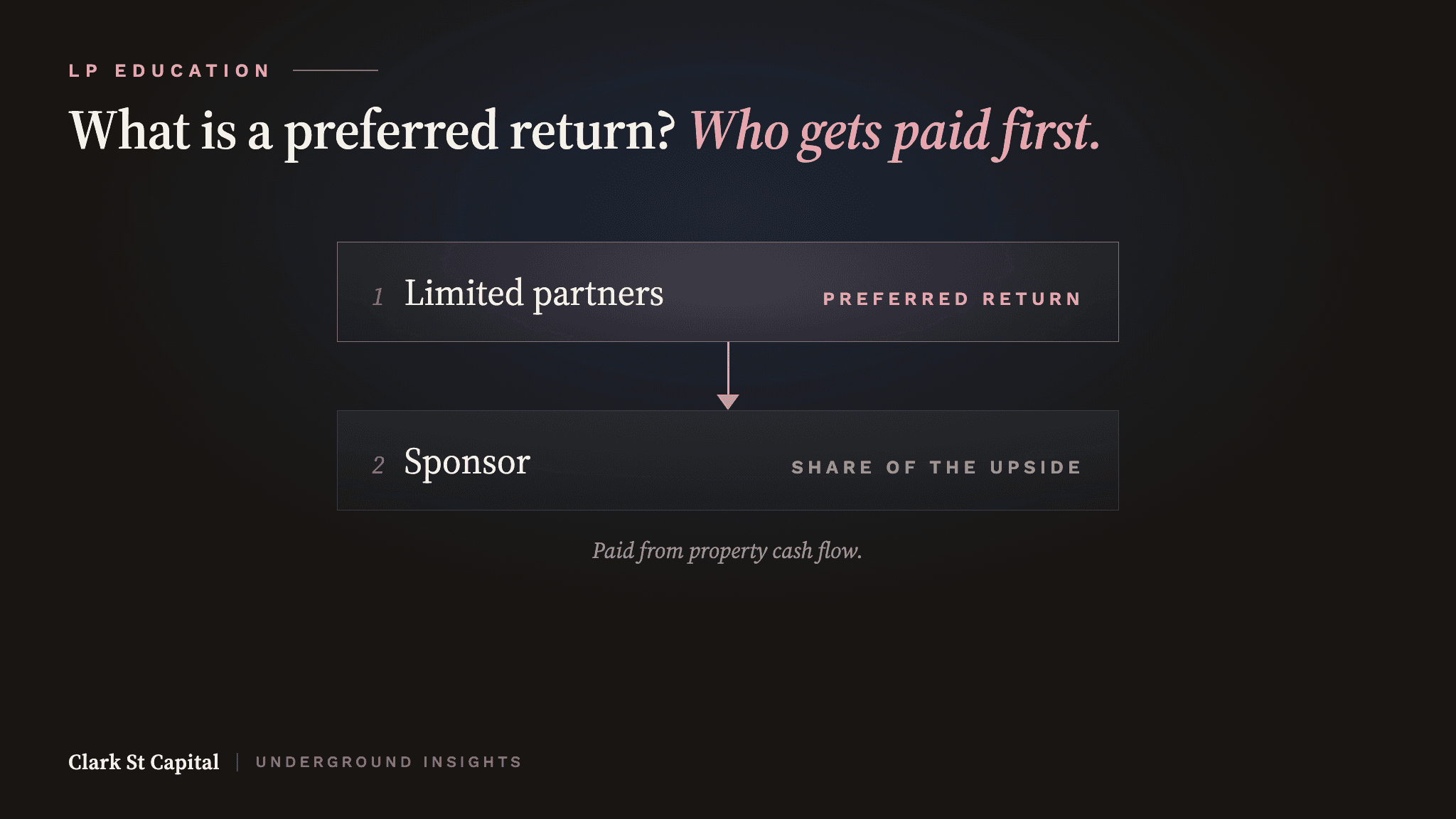
A preferred return is the first claim on profit in a real estate equity deal. Limited partners receive distributions up to a set annual rate on their capital before the sponsor shares in anything above it. The property still has to earn that cash and four terms in the operating agreement decide what happens when it falls short.
How a preferred return works
A “pref” is written into the deal's operating agreement as a percentage of investor capital that often accrues annually and is paid quarterly. Cash flow from operations, a refinance or a sale goes to the investors until they've received that rate. Only then does the rest move to the next tier of the distribution waterfall, where the sponsor's share of the profit, the promote, begins.
For example, you invest $100,000 in a deal with an 8% pref. That's a claim on $8,000 a year before the sponsor shares in the upside. Whether it's paid depends on the property. If it produces $5,000 of distributable cash that year, $5,000 is what gets paid.
What happens to the missing $3,000 depends on the terms.
Cumulative, compounding and the capital base
A law firm summary of how these provisions are drafted lays out the common variations. Here they are applied to the same hypothetical deal: $100,000 invested, 8% pref, $5,000 paid in year one.
- Non-cumulative. The $3,000 shortfall is gone. Year two starts fresh at $8,000.
- Cumulative, non-compounding. The $3,000 carries forward and must be paid before the sponsor shares in profit. Year two's pref is still $8,000 on the original $100,000.
- Cumulative and compounding. The unpaid $3,000 is added to the base. Year two's pref accrues on $103,000, which is $8,240.
- Unreturned capital. Some agreements calculate the pref only on capital you haven't gotten back yet. If the deal returns $20,000 of your capital after a refinance, the pref runs on $80,000 from then on. That's $6,400 a year.
The first three only separate in a year the property falls short, which is the year the terms matter. The capital base changes when capital comes back, usually at a refinance or a sale.
Preferred return vs. IRR
The pref is a priority rate on capital. It tells you who gets paid first and how much. IRR, internal rate of return, measures the whole investment across the entire hold. It counts every dollar in and out, including the sale, and weights each one by when it arrived.
A deal can pay its full 8% pref every year and still post an IRR below 8% if the sale returns less than the capital invested. A pref that's paid tells you the property produced cash. It doesn't tell you whether the investment made money.
Where a pref-first deal fits in your financial journey
A preferred return is a feature of an equity investment. Before comparing pref terms, decide whether equity is the right placement for this money at all.
A pref-first equity deal tends to suit an investor who has capital they won't need for the full hold period, already holds liquid reserves elsewhere and wants a share of the upside in exchange for owning the risk. The SEC's bulletin on private placements says these investments are highly illiquid and you may need to hold them indefinitely.
Liquidity should come first if the money has a job in the next few years, such as a house, tuition, a business need or an emergency fund that isn't built yet. A pref doesn't shorten the hold or let you out early.
Principal protection should come first if you're closer to spending the money than growing it. A pref protects your place in line against the sponsor. The lender on the property is still paid before any equity investor. If protecting principal is the priority, where you sit in the capital stack matters more than the pref rate. The piece on passive commercial real estate walks through those positions and debt funds vs. syndications compares the two ends directly.
Three questions help you decide for yourself:
- When might you need this money back? If it's sooner than the planned hold, equity is the wrong strategy regardless of the pref.
- What happens to your plan if distributions stop for a year? If that breaks something, the money may not belong in an equity deal at all, whatever the pref terms say.
- How much of your expected return depends on the sale? The more of it that does, the less the pref tells you about the outcome.
Once equity fits, the structure decides what you actually get. The biggest variable is when the sponsor's promote starts. In some waterfalls it starts after investors receive their capital back plus the pref. In others, it starts after the pref alone, before all capital is returned. In a deal that sells short of plan, the first structure keeps more of the proceeds with investors.
On a $100,000 investment, an 8% preferred return looks like $8,000 a year. In a year the property falls short, the operating agreement decides whether the unpaid amount carries forward, grows or disappears. Those terms are fixed the day the investor signs.
Questions to ask any sponsor about the preferred return
The answers should be in the operating agreement, not just the deck.
- Is the pref cumulative? Does unpaid pref compound?
- Is it calculated on contributed capital or unreturned capital?
- When does it start accruing, on the date you fund or a later date?
- Does the promote begin after return of capital plus pref or after the pref only? Is there a sponsor catch-up?
- Which fees are paid before investor distributions and how much do they total?
- Where did past distributions come from? FINRA has warned that when operating cash flow falls, a real estate program may try to keep payouts steady by borrowing or by returning investors' own capital. Ask whether any pref payments were funded that way.
- Can you see the waterfall run on a downside case, with the sale price below plan?
A sponsor who answers all seven clearly in writing has given you what you need to compare deals on terms instead of headline rates.
FAQ
Does a preferred return compound? Only if the operating agreement says so. A compounding pref adds unpaid amounts to the base, so future pref accrues on the larger number.
What does an 8% preferred return mean? Investors are entitled to receive up to 8% a year on their capital before the sponsor shares in profit, if the property produces the cash. On a hypothetical $100,000, that's $8,000 a year. It isn't a guaranteed yield.
Is a preferred return the same as a hurdle rate? The terms overlap. A hurdle is any return threshold that changes how profit is split. The pref is usually the first hurdle and some deals add higher ones that shift more of the upside to the sponsor.
Is a preferred return the same as preferred equity? No. A preferred return is a payment priority inside one class of equity. Preferred equity is a separate class of investment that sits between the loan and common equity in the capital stack, with its own terms.
About Ed Mathews
Ed is the President of Clark St Capital. He started investing in 2011 after analyzing deal after deal and making zero offers, until a mentor handed him a pen and made him sign his first contract. Since then, Clark St has operated across single-family, multifamily and land development, with Ed also invested as a limited partner in funds and large multifamily projects. Ed also spent more than two decades in Silicon Valley building systems for global companies. He hosts the Real Estate Underground podcast, with new episodes every Tuesday at 12pm.