A $100K investment can earn exactly what it projected and still fail the investor. Money needed for a down payment in two years does no good locked in a syndication with a five-year hold. Money in a fund that gates redemptions can take several quarters to come back.
How to invest $100K depends on five primary questions about your own situation, answered in order. The first three are facts you can't choose. Each one takes vehicles off the table before preference enters. The last two are choices about what you want the money to do and how involved you want to be.
TL;DR
- When do you need the money back?
- Which account holds the $100K?
- Are you an accredited investor?
- Do you want income now or growth for later?
- How much work and control do you want?
When do you need the money back?
Money with a job in the next few years, such as a house purchase, tuition or a business need, isn't investment money. It belongs somewhere you can reach at full value, like a high-yield savings account, a money market fund or Treasury bills. An emergency fund comes before any of this. So does high-interest debt, since paying it off is a return with no market risk.
Your time horizon sets how illiquid you can go:
- Index funds and public REITs sell on any trading day.
- Private credit and debt funds let you out on the fund's redemption schedule, subject to limits.
- Syndication equity is locked for the hold stated in the offering documents and holds can run longer than planned.
Read a fund's redemption terms as a limit the fund can enforce. When too many investors ask out at once, a gate caps withdrawals and everyone else waits.
Which account holds the $100K?
- 401(k). The plan's menu decides what you can buy. If a vehicle isn't on the menu, it isn't an option inside the plan.
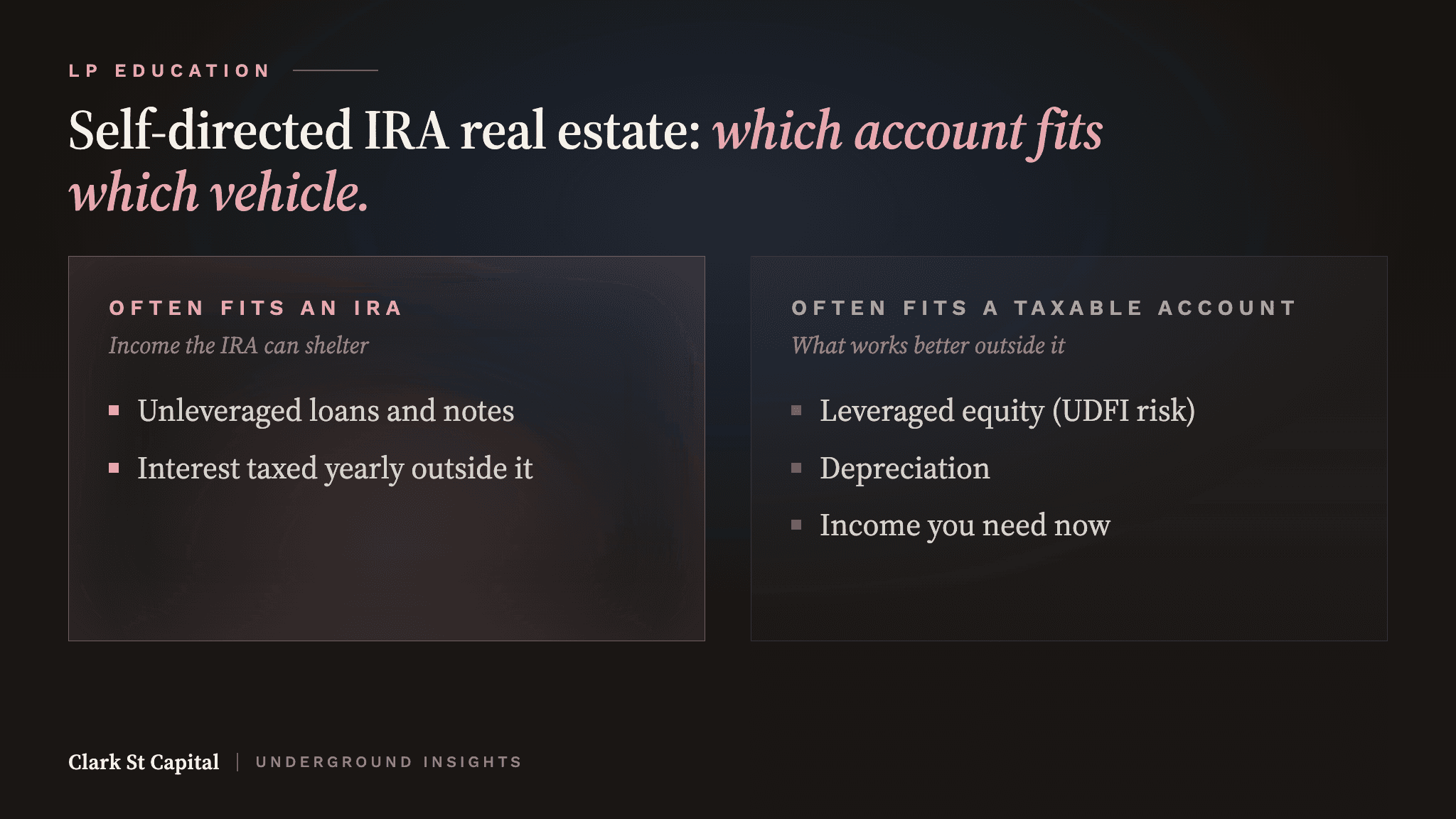
- IRA or Roth IRA. A standard brokerage IRA holds public securities: stocks, bonds, funds and public REITs. Holding a private fund or a syndication takes a self-directed IRA with a custodian that allows it and the IRS prohibited-transaction rules apply.
- Taxable brokerage. Every vehicle in this article is available. It's also where tax treatment matters most, because no account wrapper shelters the income.
Are you an accredited investor?
Most private real estate offerings are sold only to accredited investors. Under the SEC's definition, an individual qualifies with net worth over $1 million, excluding the primary residence, alone or with a spouse or partner. Income over $200,000 ($300,000 with a spouse or partner) in each of the prior two years also qualifies, if you reasonably expect the same this year. Holders of a Series 7, 65 or 82 license in good standing qualify too.
Having $100K to invest doesn't make you accredited. Having only $100K doesn't rule you out either, since income alone can qualify you.
Open to everyone: index funds, public REITs and owning a rental directly. Interval funds, non-traded REITs and non-traded BDCs are also open to non-accredited investors. They're registered products with limited, scheduled ways to sell, which the SEC's interval fund bulletin explains.
Usually requires accreditation: private credit and debt funds and LP equity in a real estate syndication.
Do you want income now or growth for later?
- Growth: index funds, plus appreciation on a rental or a syndication, collected when the property sells.
- Income: debt funds pay interest collected from borrowers. Public REITs pay dividends. A rental pays what's left after expenses and the mortgage.
Income from a debt fund comes from borrowers making their payments. If borrowers stop paying, that income stops too.
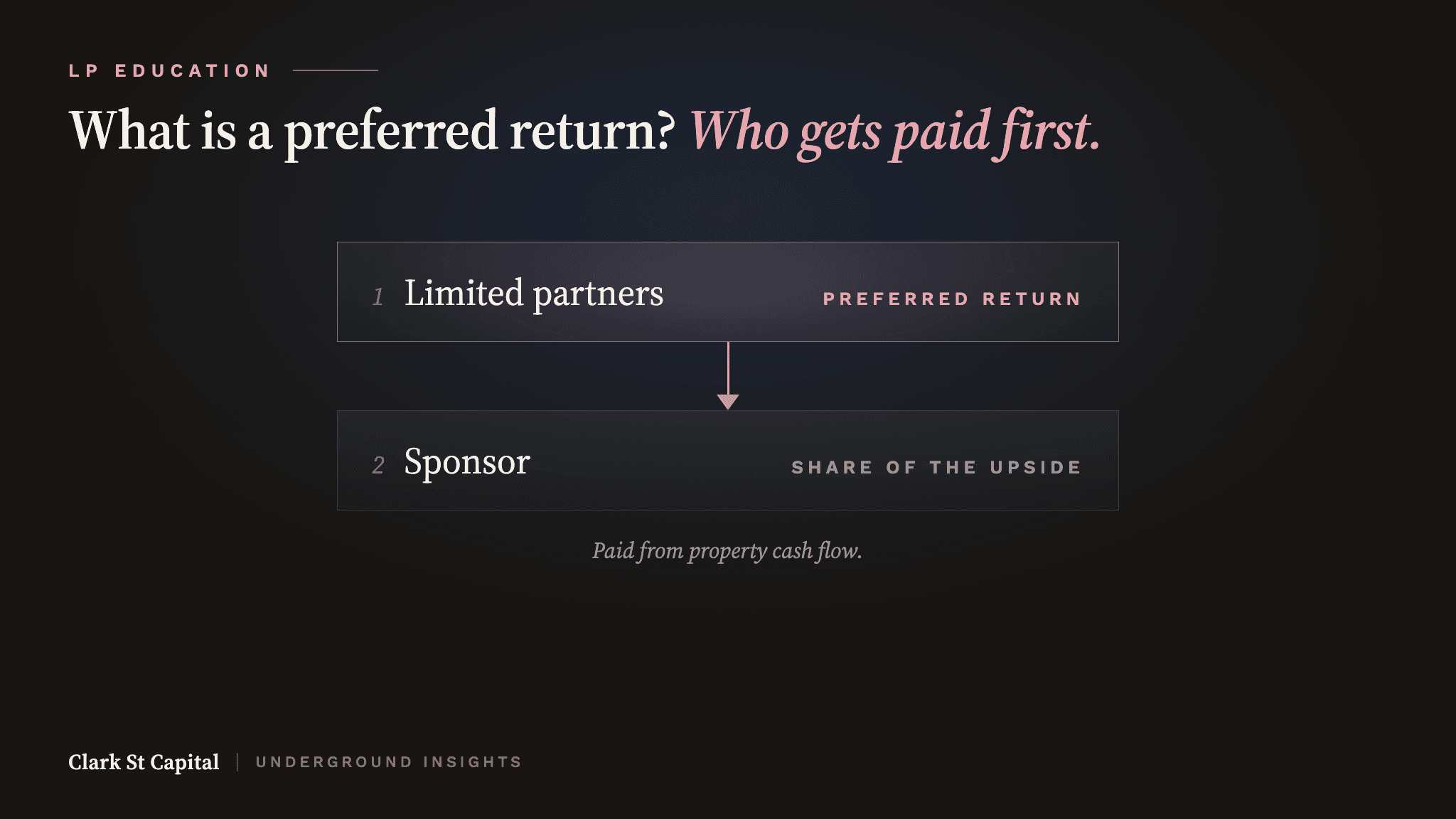
Syndications mix both, with distributions during the hold and a share of the sale at the end. The order in which investors get paid is usually set by a preferred return (“pref”). A pref sets the order of payment. The property still has to earn the cash.
How much work and control do you want?
- Owning a rental directly: full control and full work, with your risk in one property and one set of tenants.
- LP equity or a fund: no control and no work. The sponsor makes the decisions, including whether to ask investors for more money through a capital call.
- Index funds and public REITs: no control, no work and a daily exit.
If you want real estate without managing it yourself, here's how to invest in real estate without being a landlord.
How do the vehicles compare?
| Vehicle | Liquidity | Minimum | Accredited only? | Control | Income or growth | Tax treatment (general) | Main risk |
|---|---|---|---|---|---|---|---|
| Index fund | Any trading day | One share or less with fractional shares | No | None | Mostly growth | Qualified dividends and long-term gains taxed at capital-gains rates | Market drawdowns |
| Public REIT | Any trading day | One share | No | None | Mostly income | Dividends mostly taxed as ordinary income | Interest rates, market swings |
| Direct rental | Months to sell | Down payment plus reserves | No | Full | Both | Depreciation offsets rental income; a 1031 exchange can defer gain on sale | One property, leverage |
| Private credit or debt fund | Fund's redemption schedule, can be gated | Varies by offering | Usually | None | Income | Interest taxed as ordinary income | Borrower defaults, manager, liquidity |
| Syndication (LP equity) | Locked for the hold | Varies by offering | Usually | None | Both | Reported on a K-1; depreciation passes through and can be recaptured at sale | Leverage, sponsor, capital calls |
Tax cells reflect general IRS rules in Publication 550 (dividends), Publication 527 (rental property) and the IRS guidance on like-kind exchanges.
What questions fit your situation?
The three situations below are common starting points. Every person and every financial journey is different. So each one comes with questions to ask about real estate investing and the answers are yours to find.
Mid-30s, not accredited, $100K split between a 401(k) and a Roth IRA
For you and your spouse or partner
- Could any of this money be needed before retirement and for what?
- Is the emergency fund built outside these two accounts?
- Is real estate exposure the goal or is the 401(k) menu enough for now?
- Is becoming accredited a goal and what would it take?
For a real estate GP or sponsor
- Is this offering open to non-accredited investors and under which SEC rule?
- Do you accept money from self-directed IRAs and have other investors done it?
- Could this deal create unrelated business taxable income for an IRA investor?
For your financial advisor
- Which public real estate options, such as REIT funds, are available in my 401(k) and Roth?
- How much real estate is already inside the current funds?
- Would moving Roth money to a self-directed custodian to diversify into real estate make sense right now?
For your accountant
- If a Roth IRA invests in a private real estate deal, could it owe tax on unrelated business taxable income?
- Which prohibited-transaction rules would apply to a self-directed Roth?
- How would an early withdrawal from either account be taxed?
Late 40s, accredited by income, $100K in a taxable account, not needed for seven or more years
For you and your spouse or partner
- If this money stayed locked up past the planned hold, would anything in the plan break?
- How much of your net worth already rides on one employer, one industry or one home?
- Is the goal quarterly income or growth that stays untouched for retirement?
- Would accredited status hold up if one of you changed jobs?
For a real estate GP or sponsor
- What's the planned hold and what happens if the sale is delayed?
- Can you issue capital calls and what happens to an investor who doesn't fund one?
- When do K-1s usually arrive and have they ever come late enough to delay a filing?
- How much of your own money is in this deal?
For your financial advisor
- How much of the total portfolio should be illiquid and how much of that is already spoken for?
- Would a single syndication at this size concentrate too much in one property and one sponsor?
- How does this compare with keeping the money in taxable index funds for the same period?
For your accountant
- How would depreciation passed through on a K-1 affect taxes at this income level?
- Could passive losses from this offset other income or would they carry forward?
- What tax would be due at sale, including depreciation recapture?
- Would a state return be required where the property sits?
Early 60s, accredited by net worth, wants income, may need part of it within two years
For you and your spouse or partner
- How much of the $100K might be needed in the next two years and for what?
- How much income does this need to produce and when does it need to start?
- If distributions paused for a year, what would cover the gap?
- Do your heirs know about this investment and would they want to hold it?
For a real estate GP or sponsor
- When do distributions start, how often are they paid and have they ever been cut or suspended?
- What are the exact exit or redemption terms and can they be limited?
- What happens to an investor's interest if they die during the hold?
- Have past distributions ever been funded by anything other than property or loan income?
For your financial advisor
- Which part of this money should stay liquid, given the two-year need?
- How does this income fit with Social Security timing and other income?
- If some of this sits in an IRA, how would required minimum distributions work with an illiquid holding?
For your accountant
- How would income from a debt fund or a syndication be taxed in this bracket, compared with REIT dividends?
- If a private investment sits in an IRA, how is it valued for required minimum distributions?
- How would this investment pass through the estate and what tax basis would heirs receive?
What's left after the five questions?
Answer the five questions in order and the list usually shrinks to two or three vehicles. The choice left is between those. This article is general education, not personal financial, tax or legal advice.
FAQ
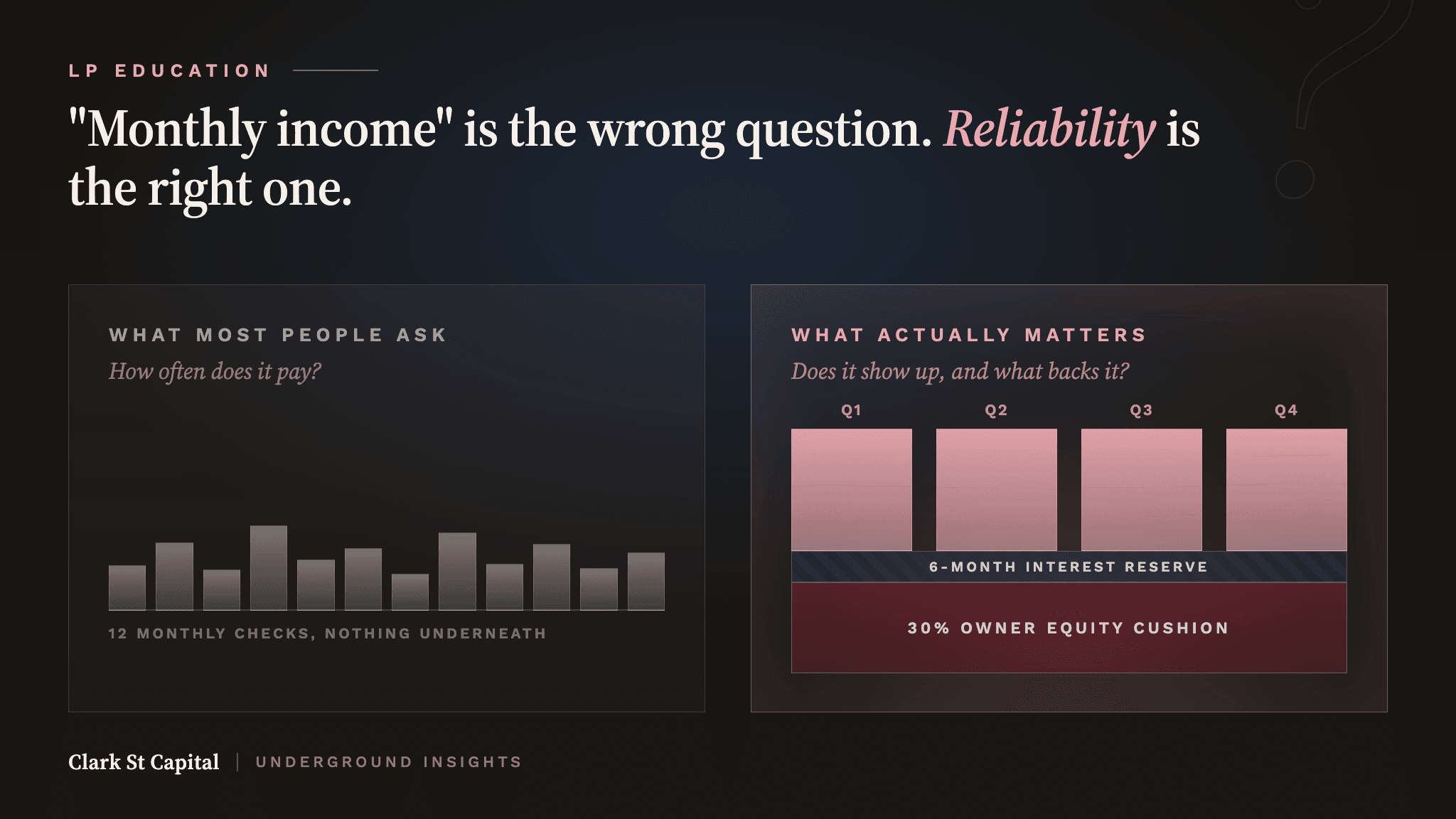
What's the best way to invest $100K for monthly income? Public REITs and debt funds both pay income on a set schedule, monthly for some and quarterly for others. Check where each payment comes from before comparing yields. No vehicle guarantees it.
Is it better to invest $100K in stocks or real estate? Stocks and public REITs are easier to buy, hold and sell. Private real estate adds income and tax treatment stocks don't have, in exchange for a long lockup and reliance on a sponsor.
Is it better to invest $100K or pay off a mortgage? Paying down the mortgage earns its interest rate with certainty. Investing may earn more, with risk. Home equity is hard to reach quickly, so keep enough liquid either way.
Always seek the advice and counsel of a qualified legal, financial, and/or accounting professional before making any decisions of this importance.
About Ed Mathews
Ed is the President of Clark St Capital. He started investing in 2011 after analyzing deal after deal and making zero offers, until a mentor handed him a pen and made him sign his first contract. Since then, Clark St has operated across single-family, multifamily and land development, with Ed also invested as a limited partner in funds and large multifamily projects. Ed also spent more than two decades in Silicon Valley building systems for global companies. He hosts the Real Estate Underground podcast, with new episodes every Tuesday at 12pm.